
Wholesale Keychain Hardware for Beginners: 2026 Guide
Table of Contents
- What Wholesale Keychain Hardware Actually Means for a Beginner
- Hardware Types You'll See in Every Wholesale Keychain Catalog
- Keychain Assembly Tools for Beginners: What to Buy First
- Starter Hardware Options for New Crafters
- Cost Analysis for Handmade Keychains: Where the Money Goes
- How to Start a Keychain Business With Wholesale Hardware
- Common Beginner Mistakes When Buying Hardware in Bulk
- Frequently Asked Questions
Last Updated: September 22, 2026
What Wholesale Keychain Hardware Actually Means for a Beginner
Buying wholesale keychain hardware means purchasing components in larger quantities at a lower per-unit price than retail packaging allows. For beginners, "wholesale" often just means buying multi-packs or small bulk lots rather than single pieces.
Hardware Types You'll See in Every Wholesale Keychain Catalog
Every catalog carries the same core categories in different finishes and quantities. Learning the names saves you from ordering the wrong thing twice, but learning the sizes prevents returns.
Split Rings, D-Rings, and Swivel Hooks
Split rings are the double-loop metal rings you thread keys onto, sold by outside diameter in millimeters: 25 mm handles a normal key set, 20 mm a lighter set, and 12-15 mm single-key or decorative keychains. Wire gauge matters too, a thicker gauge resists pulling open but is harder to thread beads onto.
Slide Buckles, Lobster Clasps, and Jump Rings
Lobster clasps are the spring-loaded clips you squeeze to open, letting a user detach keys from a bag or belt loop. The silver keyring with lobster clasp from Barkers Creative Designs costs $0.60 and suits wristlets and keychains.

Compatibility: Matching Hardware to Webbing and Beads
This is where beginners lose the most money. Use these pairings as a starting reference:
| Component | Match It To | Common Beginner Mistake |
|---|---|---|
| 1 inch D-ring | 1 inch webbing | Buying 3/4 inch D-ring for 1 inch strap |
| 3/4 inch slide buckle | 3/4 inch webbing | Mixing metric and imperial widths |
| 25 mm split ring | Full key set (5+ keys) | Using 12 mm ring on a heavy set |
| 20-gauge jump ring | Charms, light loads | Using 22-gauge on load-bearing joints |
| 15 mm beadable bar | 15 mm silicone beads | Ordering 12 mm beads for a 15 mm bar |
| 8 inch cup charm wire | 15 mm beads + spacers | Cutting wire too short to finish the loop |
| Hardware | What It Does | Typical Use |
|---|---|---|
| Split ring | Holds keys on a loop | Standard keychain base |
| D-ring | Provides an attachment point | Wristlets, lanyards |
| Swivel hook | Rotates without twisting | Bag clips, belt loops |
| Lobster clasp | Detaches with a squeeze | Clip-on keychains |
| Jump ring | Joins two components | Connectors, charms |
| Slide buckle | Adjusts strap length | Adjustable lanyards |
Keychain Assembly Tools for Beginners: What to Buy First
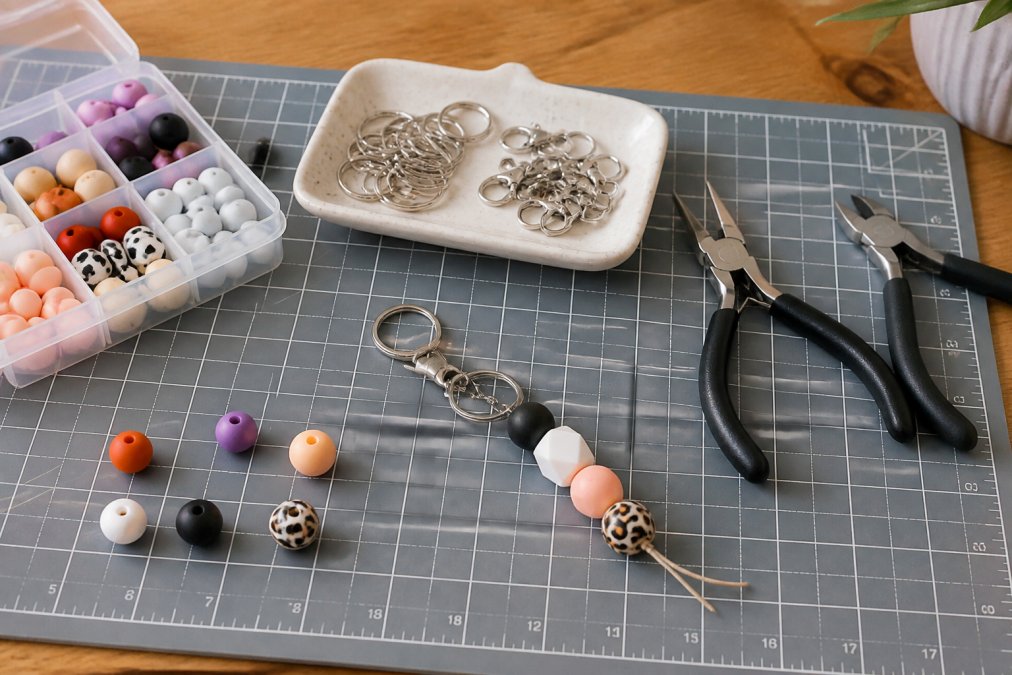
You need three tools to assemble keychains, and you probably own one already. Flat-nose pliers, round-nose pliers, and a small wire cutter cover almost every beginner assembly task.
Starter Hardware Options for New Crafters
The best starting point for a new crafter is a pre-assembled DIY kit, not a bulk hardware order. Kits remove the guesswork about which components fit together, the biggest source of wasted money for beginners.
- DIY Beaded Pen Kit, $5.00: One pen with black ink, a silicone focal, two abacus beads, and two rhinestone spacers. No tools needed; the top screws on with a twist.
- DIY 10 inch Wristlet Kit, $8.00: A 10 inch wire, lobster keychain, spacers, 18 beads, and a focal. Pliers are helpful but not required.
- DIY Tumbler Cup Charm Kit, $10.00: Two 8 inch cup charm wires that make two completed charms, each 3 inches round. They hang from a tumbler, bag, luggage, or keys.
- Beadable bar keychain, $1.75: A 3 inch beadable bar with a lobster clasp in black metal. Add your own beads.
- 15 mm Solid Silicone Beads 20 pack, $3.00: BPA-free, food-safe silicone beads in your chosen color.
- 15 mm Silicone Bead Mixed Bags, $7.00: 30 to 60 beads per bag, including printed and solid beads, with some focals mixed in.
- 12 mm Silicone Lentil spacers, 40 count, $2.50 and 14 mm Silicone Abacus spacers, 20 count, $2.50: Mixed-color spacers that fit over a loop turner and work on cup charm wires.
Cost Analysis for Handmade Keychains: Where the Money Goes
Most of a handmade keychain's cost sits in the beads and focals, not the metal hardware. Metal components are cheap per unit; decorative silicone is where your budget goes. Here is how to build a cost-per-unit sheet.

The Cost-Per-Unit Formula
For each finished piece, add up:
- Hardware, split ring, clasp, jump rings, any D-ring or swivel hook
- Beads and spacers, count every bead on the strand, including spacers
- Focal bead, usually one piece, often the priciest bead on the strand
- Wire or cord, the beadable wire or charm wire, divided by how many pieces one pack makes
- Packaging and labeling, bag, tag, backing card, sticker
- Payment and platform fees, if you sell online, subtract these before calling anything profit
Divide the pack price by the number of pieces in the pack to get a per-piece cost, the habit that separates makers who know their margins from makers who guess.
A Worked Example
Say you build a beaded keychain using:
- One lobster clasp keyring at $0.60
- Two jump rings from a pack that works out to about $0.02 each
- One 15 mm focal bead and roughly ten 15 mm beads and spacers from a mixed bag
- A few inches of beadable wire from a 10-pack
If the bead bag cost $7.00 and yielded enough beads for several keychains, your bead cost per piece might land in the $1.00-$2.00 range. Hardware stays under $1.00, wire is pennies per piece, and packaging adds whatever your bag and tag cost.

Why This Matters for Pricing
Sell a finished keychain for $10.00 with $3.00 materials and you have $7.00 before time and fees; with $6.00 materials from a premium focal, you have $4.00. Same selling price, very different outcome, and the difference is almost entirely in the beads.
Where to Save and Where Not To
- Save on: split rings, jump rings, and plain spacers. These are commodity parts; buying them in larger packs rarely hurts.
- Do not cheap out on: lobster clasps and swivel hooks that see daily use, and any bead a child might mouth. A failed clasp means a returned product.
- Watch shipping: a lower unit price with a long lead time can cost you a craft fair deadline. Factor delivery into the per-unit number, not just the sticker price.
How to Start a Keychain Business With Wholesale Hardware
Starting a keychain business begins with a small, repeatable product line, not a wide catalog. Pick two or three designs, source components in slightly larger quantities, and sell those until you know what buyers want.
The sequence that works:
- Finish five sample pieces using kits or small bead packs.
- Photograph them and test demand at a craft fair or online listing.
- Identify your two best sellers.
- Order those specific components in larger quantities.
- Track cost per unit and adjust pricing.
Vetting Suppliers and Checking Plating Quality
Plating quality is the difference between hardware that looks new after a year and hardware that flakes in a month. Ask a supplier directly what the base metal and plating are, and whether they have a minimum order quantity.
Common Beginner Mistakes When Buying Hardware in Bulk
Ordering too much of one component costs beginners the most money. Hardware is cheap per piece, so a large quantity feels low-risk until you realize you chose the wrong size.
Other mistakes worth avoiding:
- Mixing incompatible gauges. A jump ring that is too thin for the load will open under normal use. Match hardware gauge to the weight of the finished piece.
- Ignoring finish consistency. Silver, gold, and gunmetal finishes from different suppliers rarely match exactly. Order the full set from one source when a design depends on matching metal.
- Forgetting that beads and hardware are sold separately. Most beadable components ship without beads. Check the listing before you assume a kit is complete.
- Overlooking shipping and lead times. A cheaper unit price with a long lead time can stall a craft fair deadline. Factor delivery into your planning, not just price.
- Buying hardware before beads. Since beads dominate your cost, lock in your bead supply first, then match hardware to it.
Frequently Asked Questions
Where can I find bulk keychain supplies?
Start with a craft supplier that sells hardware and beads in the same place, so you can match finishes and sizes in one order. Small packs of split rings, swivel hooks, and lobster clasps are the easiest entry point because you can test quality before committing to larger quantities. Once you know which sizes and metal finishes work for your designs, you can buy bigger packs and lower your cost per unit. Ordering beads and hardware together also saves on shipping and keeps your colors consistent.
Is a keychain business profitable?
It can be, but the margin depends on your hardware cost per unit. A single keyring with a lobster clasp costs well under a dollar, and a small pack of silicone beads spreads across many finished pieces, so a simple keychain can be assembled for a few dollars in materials. The profit comes from volume and pricing. Track every component, including packaging and shipping, then set a retail price that leaves room for craft fair fees and returns.
What hardware is needed for DIY key fobs?
Most beginner fobs need a keyring or split ring, a lobster clasp or swivel hook, and a connector such as a jump ring or D-ring to attach the beaded section. For beaded styles, you also need a beadable bar, charm wire, or wristlet wire sized to your beads. A pair of pliers helps with opening and closing rings, though many kits need no tools at all. Match your hardware gauge to the bead hole size so everything strings and hangs correctly.
How much should a homemade keychain cost to make?
A basic beaded keychain usually costs a few dollars in materials once you break down the price of each component. For example, a silver keyring with a lobster clasp is $0.60 and a beadable bar keychain is $1.75, and a 20 pack of 15 mm solid silicone beads is $3.00, which works out to about $0.15 per bead. Spacers and focals add a little more. Buying hardware in larger packs and using mixed bead bags brings the per-unit cost down further.
How do I check plating quality and corrosion resistance before buying in bulk?
Ask the supplier what metal the hardware is made from, since zinc alloy with a plated finish is common in keychain hardware. Before a large order, buy a small pack and wear-test one piece on your own keys for a couple of weeks. Watch for flaking, dulling, or green marks where the finish rubs against skin and fabric. If the plating holds up in daily use, the batch is likely safe to scale up. Skip any supplier who cannot tell you the base metal.